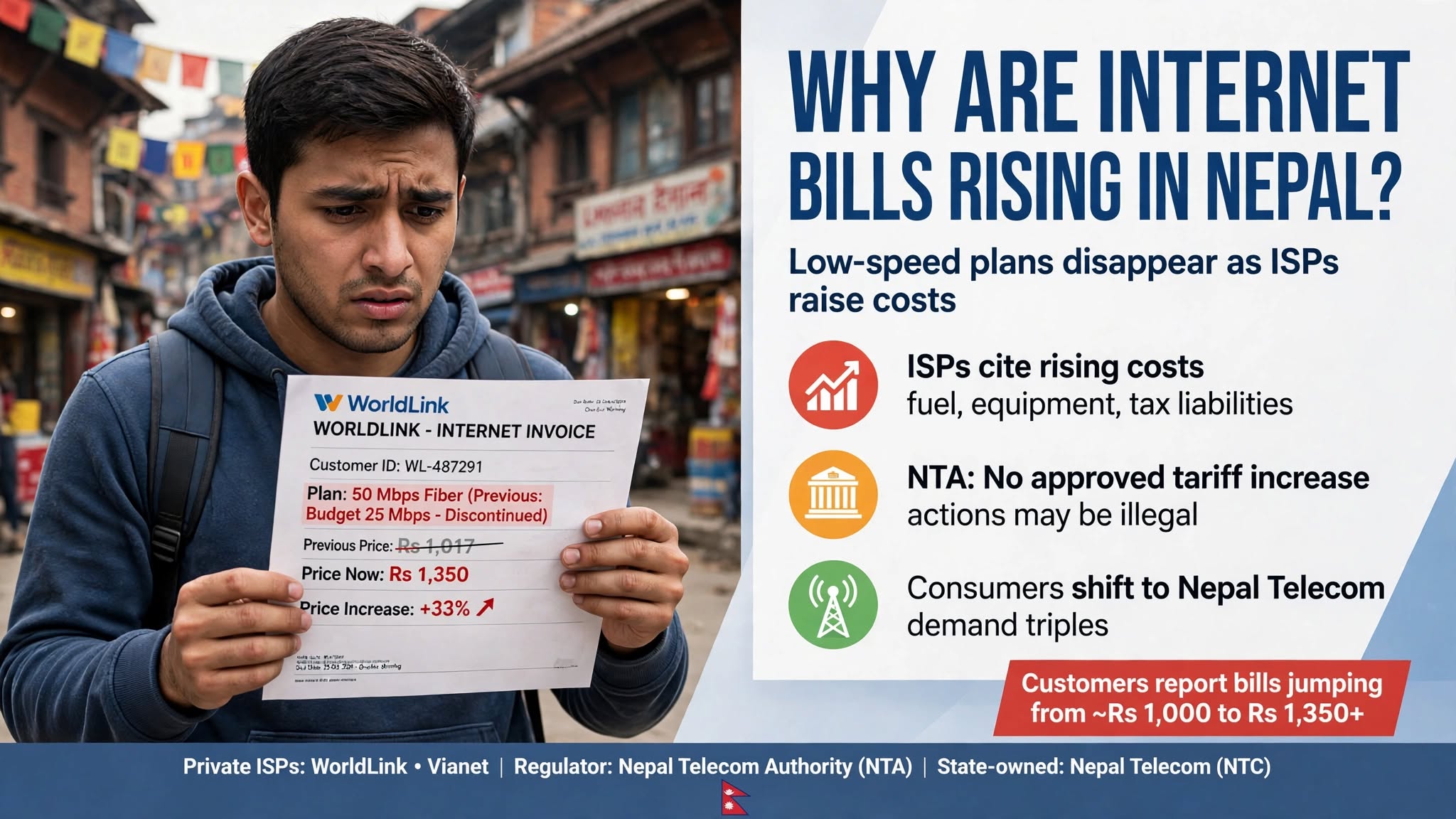
If your monthly internet bill suddenly jumped, or your cheap low-speed package disappeared, you are not alone. Over the past few weeks, customers across Nepal have taken to Facebook and X to complain about unannounced price hikes and the removal of budget internet plans by private Internet Service Providers.
But what is actually driving these increases? Is it just greed, or are there deeper economic, tax, and legal factors? Here is what we know from ISP statements, regulator notices, and court reports, and what is still disputed.
What Changed for Customers?
The most immediate change is the removal of low-speed, budget-friendly packages. Major private ISPs have stopped offering plans below 50 Mbps, according to reports and customer complaints.
For students and low-income families who only needed a basic connection, this is a big blow. Internet Service Providers have warned that they may discontinue low-priced internet packages, citing rising operating costs, even as the government moves to expand affordable broadband.
One WorldLink customer, Anup Thakuri, complained on Facebook that his monthly bill for a 50 Mbps Special BTL package had risen from Rs 1,017 in September to Rs 1,350 in October. That is his claim, reported in the press, not a verified bill from WorldLink. Many other users have shared similar stories of paying more for the same or slower service.
The key point is this: customers feel the price rise, but the regulator says the rise was never approved. That gap is the core of this dispute.
What Do the ISPs Say? Their 3 Main Claims
The Internet Service Providers Association of Nepal (ISPAN), the umbrella body of private ISPs, says cheap packages are no longer sustainable. Here are their claims, in their own words, not as proven facts:
1. Rising operational costs
ISPAN says global inflation, fuel prices, and higher costs for transport and maintenance have made low-priced plans unviable. This is their argument, and it has not been independently audited in public.
2. Equipment costs
Industry representatives claim the price of chipsets, fiber equipment, and network gear has risen, partly due to global demand for AI hardware. Again, this is an industry claim, not a figure confirmed by NTA.
3. Tax and royalty liabilities
This is the most concrete part. ISPs say a recent Supreme Court decision has created a large financial burden. We explain this in detail below, because it is often confused with the price hike itself.
The Tax Issue: What the Supreme Court Actually Decided
This part is often misreported, so let us be clear. There are two separate tax issues:
A) Royalty and RTDF: Rs 3.64 billion
The NTA has ascertained the financial liabilities of ISPs at Rs 3.64 billion under royalty and Rural Telecommunications Development Fund (RTDF) charges on maintenance fees collected since fiscal year 2017/18. The Supreme Court scrapped eight writ petitions filed by WorldLink, clearing the way for the government to collect royalty and RTDF from ISPs.
B) TSC allegation: Rs 7.36 billion claimed
Separately, the Department of Revenue Investigation concluded that some top ISPs were not paying Telecommunication Service Charge (TSC) on maintenance fees, and it was reported that WorldLink might have to pay Rs 7.36 billion in taxes. This is an allegation and investigation figure, not a final court-confirmed bill for all ISPs.
ISPs argue these liabilities make it hard to keep prices low. Critics argue ISPs collected maintenance fees from customers for years and should have already paid the dues. Both sides are partly right, but the court has now sided with the government on the royalty and RTDF part.
What Does the Regulator Say? NTA Says No Hike Was Approved
This is where it gets confusing for ordinary users.
The Nepal Telecommunications Authority (NTA) has clarified that internet service charges have not increased, warning providers of action if they charge more than approved rates. Responding to media reports, NTA said it had not received any proposal from ISPs to increase prices.
Under the rules, each ISP must submit proposed tariff rates to the NTA for approval at least three months before implementation. NTA says that process was not followed.
NTA has warned ISPs against raising prices without approval and said charging more than approved rates is a violation.
NTA Fined 14 ISPs, But the Fine Is Small
NTA did take action. It fined 14 ISPs Rs 50,000 each for violating tariff rules and offering unauthorized internet packages. The NTA fined 14 ISPs after inspections found violations involving approved tariffs, packages and regulatory directives, while affected customers can seek compensation.
For a large ISP, Rs 50,000 is a very small fine. That is why many consumers feel the enforcement does not match the scale of the price increase. NTA also said affected customers can seek compensation for losses, but it has not published a simple process for how to claim it.
Why Are You Paying More If No Hike Was Approved?
There are three ways you might be paying more, even without an official tariff hike:
- Your cheap plan was removed. If your 20 Mbps or 30 Mbps plan is gone, you are forced to buy a 50 Mbps plan at a higher price. That is not a tariff hike on paper, but it is a price hike in practice.
- Your package was changed. Some users report being moved to a new package name with a higher bill, without clear consent.
- Hidden charges. Maintenance fees, router charges, or installation fees can increase your total bill even if the headline speed price looks the same.
This is why NTA's statement "prices have not increased" and your bill showing a higher amount can both be true at the same time.
The Shift to Nepal Telecom
As frustration grows, many customers are turning to state-owned Nepal Telecom. Its 30 Mbps fiber for Rs 4,999 per year, with free installation, has seen a surge in demand. Nepal Telecom reported that requests for new connections tripled, and new connections doubled in recent months.
But NTC also has problems: long waits on its 198 hotline, installation delays, and complaints about old single-band routers for the 30 Mbps pack. It is cheaper, but not faster to get.
What Can Consumers Do? 4 Practical Steps
1. Check your approved rate
Go to your ISP's website and NTA's approved tariff list. Compare your bill with the approved rate for your exact package name. Screenshot both.
2. Ask for written proof
Ask your ISP in writing, on Facebook Messenger, email, or at their office: "What is my approved package, speed, and monthly price? When was it approved by NTA?" Keep the reply.
3. File a complaint with NTA
If you are charged more than the approved rate, file a complaint with NTA with your bill and screenshot. Also file with your ISP first, so you have a complaint number.
4. Consider alternatives, but check first
Before switching to NTC or another ISP, check coverage, FUP, router type, and installation time. Do not cancel your old connection until the new one is working.
Frequently Asked Questions
Did NTA approve the price hike?
No, according to NTA. NTA says it has not received any proposal and has not approved any increase. It has warned ISPs and fined 14 ISPs for unapproved packages.
Why did my ISP remove my cheap plan?
ISPs say low-priced plans are no longer sustainable due to costs and tax dues. NTA says ISPs cannot remove or change approved packages without approval. This is the disputed part.
Can I get compensation if I was overcharged?
NTA says affected customers can seek compensation. In practice, you will need your bills, proof of approved rate, and a written complaint. There is no automatic refund system announced yet.
Conclusion
The internet is no longer a luxury in Nepal. It is essential for education, work, and daily life. The current dispute is not just about Rs 200 or Rs 300 more per month. It is about who decides prices, how tax dues are handled, and whether regulation can keep up with a fast-changing market.
Until NTA, ISPAN, and the government agree on a clear, published tariff list, consumers will remain confused. For now, the best protection is to keep your bills, check approved rates, and complain in writing.
Did your bill go up? Which ISP, which package, and how much did it change from September to October? Share in the comments with proof, it helps others compare.
Sources: Kathmandu Post, My Republica, The Himalayan Times, NTA press releases via Nepalitelecom.com. ISP claims are attributed to ISPAN and are not independently verified. Prices verified as of November 20, 2026.